Drive every agent with one protocol
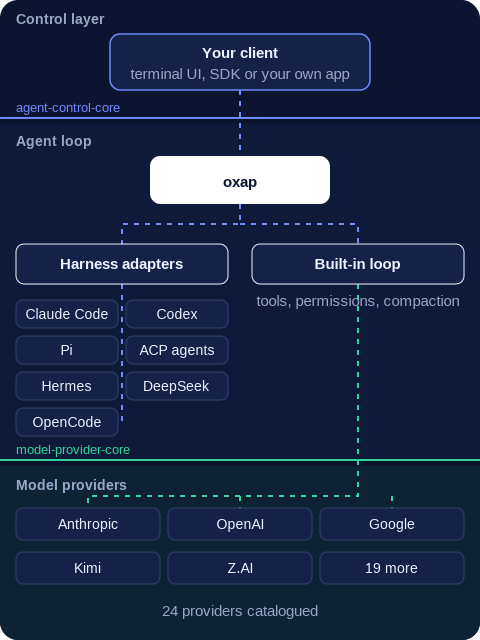
OXAP is a layered protocol for agent software. Your client speaks one set of envelopes to oxap. Behind it, adapters run Claude Code, Codex and other harnesses, and oxap's own loop calls model providers directly.
Install oxap or follow the quickstart
Alpha: v0.1.0-alpha.47. Know it as OAP? Same project and same wire, new name.
Layers, not deployment sides
OAP layers are logical software boundaries: presentation, control layer, agent loop, model provider, tool executor, resource provider and binding. They can live in one process or across transports and keep the same protocol semantics.
Two boundaries have profiles today. agent-control-core sits between a control layer and an agent loop: sessions, runs, streamed content, tool calls, permission prompts and cancellation. model-provider-core sits below the loop: one inference request, and its parts as they stream. oxap can serve both on one connection.
Where your messages can go
Client and UI builders
Drive any agent the same way
Speak agent-control-core envelopes once and reach oxap's own agent loop, your own agent, or a third party harness behind oxap.
Harness authors
Put your runtime behind a standard endpoint
Use a pinned adapter (claude, codex, pi, acp, hermes, deepseek, opencode) or implement the profile natively and check it with the conformance runner.
Model providers
Serve models on the same wire
Serve model-provider-core over stdio or HTTP. The oxap agent loop is itself a client of this profile, so a remote provider can stand in for the local one.
Implementers and reviewers
Read and shape the contract
STABILITY.md states the v0.1 pre-release contract. IMPLEMENTERS.md puts you on notice of proposed breaking changes.
Fair questions
It is alpha. Will the wire change?
It can. Until the first v0.1 release, v0.1 is a pre-release working contract. After that release, everyone on the IMPLEMENTERS.md register is sent a proposed breaking change at least 30 days before it can land.
Why another agent protocol?
Because one envelope covers both boundaries: a client driving an agent, and an agent loop doing model IO. It does not ask you to drop the runtimes you use. Pinned adapters bring Claude Code, Codex, Pi, ACP agents, Hermes, DeepSeek and OpenCode onto the same wire.
Who else implements it?
Nobody outside the project yet: the IMPLEMENTERS.md register is empty today. The oxap binary and the SDKs in the repository are the implementations so far, and the conformance runner can judge yours.
What is in the package
- Specification drafts and recorded decisions.
- A JSON Schema bundle with executable conformance fixtures.
- SDKs in Go, Python, Rust and TypeScript.
oxap, one binary that serves both profiles, runs its own agent loop, and adapts third party harnesses onto the same wire.
OXAP is the new name of Open Agent Protocol (OAP). The wire is unchanged and oapx still works as an alias.
Send your first one
npm install -g @oxap/cli
oxap auth providers
oxap auth login --provider <id>
oxap run --backend claude "write a haiku about rivers"
Release archives for macOS, Linux and Windows (arm64 and x64) are on GitHub releases. Next: all install methods and the quickstart.